Custom Pantry Design and Installation in Lakeland, Florida: A Homeowner’s Guide
You’ve probably had this moment. You open your pantry, stare at the jumble of half-empty cereal boxes, expired sauces, and that bag of flour you swore you didn’t buy last week, and think there has to be a better way. Maybe the wire shelves are sagging under the weight of canned goods. Maybe your spice jars keep tipping over because there’s nowhere to actually stand them upright. Maybe you can’t see what’s in the back without pulling everything out first.
A good custom pantry isn’t about making your kitchen look like a magazine spread. It’s about ending those small daily frustrations that pile up over the years. When your storage actually fits how you cook, shop, and live, the whole kitchen starts working better.
If you’re in Lakeland or anywhere across Central Florida and you’re tired of fighting your pantry, it’s worth a quick conversation about what’s possible. You can request a free consultation and we’ll come look at your space, ask how you actually use it, and walk through some options. No pressure, no surprise pricing.
What “Custom” Actually Means in Pantry Design
The word “custom” gets thrown around a lot in the storage world, so it’s worth being specific.
A true custom pantry is designed around your space and your habits. The shelf depths, drawer heights, spacing between sections, and the materials themselves are all chosen for what you actually store and how you reach for it. That’s different from a modular system, which uses pre-made components in standard sizes and shuffles them around to mostly fit your space. Both have a place, but they aren’t the same thing, and the difference shows up every time you open the door.
Most Lakeland homes we work in have either a small reach-in pantry near the kitchen or a walk-in pantry tucked off to the side. Builder-grade versions of both usually come with the same setup: a few wire shelves at fixed heights, a single bare bulb overhead, and a lot of wasted vertical space. There’s almost always more storage hiding in that footprint than the original layout uses.
Our custom pantry service starts with measuring the actual space, talking through what you need to store, and designing around both. The result fits your room, not somebody else’s idea of an average kitchen.
Start With How You Actually Use Your Pantry
Before you think about finishes or features, think about your habits. This is where good design lives or dies.
Are you a Costco shopper with bulk paper towels and a 24-pack of sparkling water to find a home for? Do you bake regularly and need flour, sugar, and bins of specialty ingredients within easy reach? Do small appliances like a stand mixer, air fryer, or slow cooker live in the pantry to keep your counters clear? Is this also where you stash dog food, cleaning supplies, or reusable grocery bags?
Every honest answer to those questions changes the design. Bulk shoppers need deep, sturdy lower shelves and floor space for bigger items. Bakers benefit from pull-out canisters and labeled bins at counter height. Appliance storage usually means a dedicated landing zone with an outlet, so you can plug in and actually use the mixer right where it lives. None of that happens by accident. It happens because somebody asked the right questions before drawing the first line.
Layout Options That Work for Central Florida Homes
Most Central Florida homes built in the last 20 years fall into a handful of common patterns, and each one calls for a slightly different pantry approach.
Reach-In Pantries
These are the standard closet-style pantries, usually 24 to 36 inches wide and tucked beside the fridge or in a nearby hallway. They have far more potential than people realize. The trick is using the full depth and height. Pull-out shelves or drawers solve the “items lost in the back” problem. Door-mounted racks add storage for foil, plastic wrap, and spices without eating into the main shelves. A reach-in done right can hold as much as a small walk-in.
Walk-In Pantries
If you have a walk-in, you’ve got room to think in zones. Heavy items go low. Daily-use items sit at eye level. Backstock and rarely-used appliances go up high. A small ledge of counter space inside the pantry, even just 12 inches deep, gives you a place to set down a grocery bag or load up a tray.
Butler’s Pantries and Pass-Throughs
A lot of newer Lakeland builds have a butler’s pantry between the kitchen and dining room. These are great candidates for a custom wall unit approach with cabinet fronts, glass uppers for display, and a coffee or beverage station built in. They straddle the line between pantry and showpiece, and they’re worth designing carefully.
Pull-Out Pantries
In smaller kitchens, a tall pull-out cabinet between the fridge and wall can do real work. Six or eight slim shelves slide out toward you, every item visible, no digging required.
Materials and Finishes That Hold Up to Florida Humidity
Florida humidity is real, and it affects what you should build a pantry out of.
Basic particle board with a thin melamine wrap is the cheapest option, and it works fine in a low-use area. Inside a pantry that opens and closes all day, where humid air sneaks in every time you walk through from the air-conditioned kitchen, it can swell and chip over time. We typically recommend stepping up to thicker, higher-grade materials with sealed edges, which hold up much better in our climate.
Solid wood shelving looks beautiful and lasts a long time, but it costs more and needs to be properly sealed. Painted MDF works well for cabinet fronts and gives you a clean, modern look without the price of solid wood.
Hardware matters too. Soft-close hinges and drawer slides cost a little more upfront and pay you back every time a drawer doesn’t slam shut on a hot afternoon. Wire baskets should be epoxy-coated rather than bare metal, since rust shows up fast in Florida air.
Storage Features That Actually Earn Their Keep
There’s a long list of pantry features out there, and not all of them are worth the money. A few consistently are.
Adjustable shelving is probably the single most useful feature. Your storage needs change. New appliance, new cooking habit, kid grows up and stops wanting fruit snacks on every shelf. Being able to move shelves without tools means your pantry keeps working as your life shifts.
Deep drawers for canned goods are a quiet upgrade in usability. You can see every can at a glance instead of stacking them three deep on a shelf. Pull-out wire baskets work well for potatoes, onions, and produce that needs airflow.
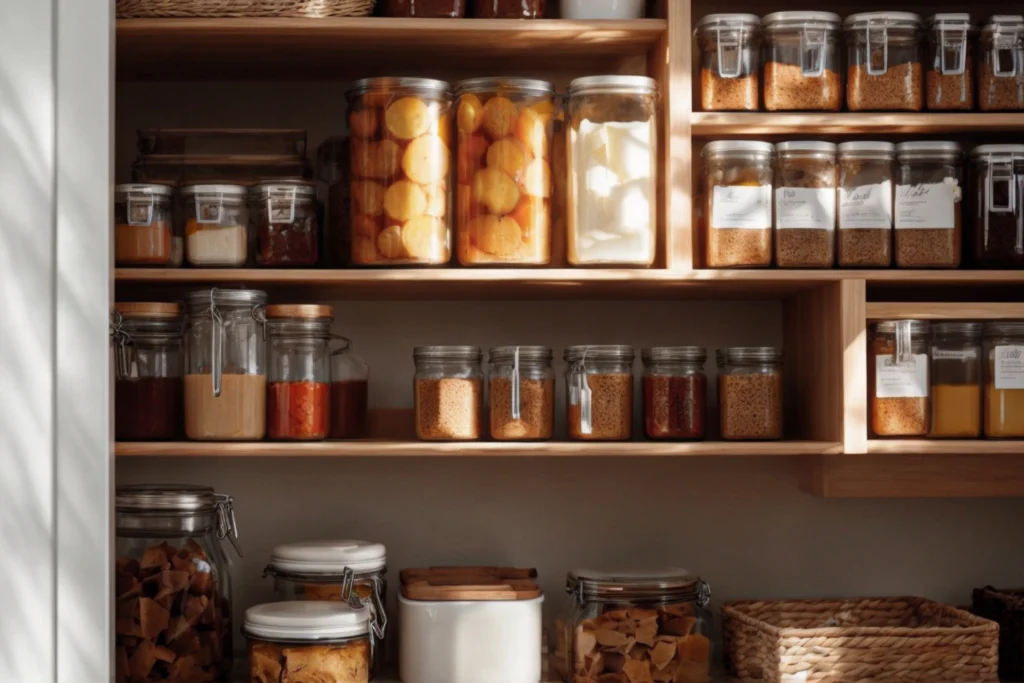
Door storage for spices, foil, and wraps is one of the highest-value features per square inch. Glass canisters or uniform bins for flour, sugar, oats, and snacks aren’t just for looks. They keep pests out, which matters in Florida, and they make it obvious at a glance when you’re running low.
If your pantry doubles as small appliance storage, build in an outlet or two. Plugging in the air fryer or coffee grinder right where it lives is the kind of thing you don’t realize you needed until you have it.
Lighting and Ventilation in a Florida Pantry
A single bulb on the ceiling isn’t enough. Under-shelf LED strips light up what you’re actually looking at, and they cost very little to add during installation. Motion-sensor lights that switch on when the door opens are a small upgrade that gets used every single day.
Ventilation is worth thinking about too. A pantry that stays sealed all day, in a humid climate, can develop musty smells or even mildew on stored paper goods. A small vent or a louvered door helps air move. Sometimes that’s enough. In larger walk-ins, we occasionally recommend a small dehumidifier or a vent tied into the main HVAC system.
What the Installation Process Actually Looks Like
If you’ve never done a custom storage project before, the unknowns are usually what hold people back. Here’s the short version of how it works with us.
We start with an in-home consultation. We measure, we talk, we look at how you actually use the space. From there, we put together a design and a clear price. Once the design is approved, we order materials, build out as much as possible offsite, and schedule installation. Most pantry installs wrap up in a day or two, depending on size and complexity. There’s no week-long disruption to your kitchen.
You can see examples of completed projects in our portfolio, which gives you a feel for the kind of work we do and the range of styles we’ve built across Central Florida.
Common Mistakes to Avoid
A few patterns come up over and over in pantries that don’t work.
Building too deep is a big one. Shelves deeper than 14 to 16 inches for general goods turn into black holes where things disappear. For most items, shallower shelves you can see across beat deeper shelves you have to dig through.
Ignoring the floor is another. The bottom 18 inches of a pantry is prime real estate for bulk items, pet food, and pull-out bins, but a lot of designs leave it as a single low shelf with three feet of dead air above it.
Skipping the lighting upgrade is the third. It’s inexpensive during the build and almost impossible to retrofit cleanly later. Spend the small amount now and save yourself the regret.
Ready to Talk About Your Pantry?
A pantry that works is one of those upgrades you stop noticing after a few weeks because it just feels normal. The frustration is gone. You know where everything is. You stop buying duplicates of the spice you already had. The kitchen runs smoother, and dinner gets a little easier.
If that sounds like the kind of change you’d like to make, we’d be glad to help. Gismondi Interiors designs and installs custom pantries, built-in closets, mudrooms, and custom storage for homeowners across Lakeland and Central Florida. Everything we build is made to fit your space and built to last.
Reach out for a free consultation when you’re ready. No hard sell, no surprise pricing, just a real conversation about what would actually work for you